The warehousing and logistics sector is entering 2026 under continued pressure. Economic uncertainty, geopolitical disruption, labour shortages and sustainability targets are reshaping how space is planned, used and valued. At the same time, demand for capacity is rising, driven by e-commerce, reshoring and the growth of sectors such as self-storage.
Against this backdrop, businesses are being forced to look more closely at how they use the space they already occupy. Industrial land is scarce, development pipelines are shrinking and costs continue to rise. Rather than expanding outward, many organisations are now expanding upwards.
Mezzanine floors sit at the centre of this shift. When designed correctly, they allow warehouses and logistics facilities to increase capacity, adapt layouts and prepare for automation without relocating or disrupting operations. Below, we explore the Top 10 warehousing and logistics trends for 2026 and explain how mezzanines help businesses respond to each one.
Why is this important?
Across warehousing and logistics, decision-makers are balancing short-term operational pressures with long-term strategic planning. Facilities must perform today while remaining adaptable for tomorrow.
Mezzanine floors offer a practical way to manage this tension. Rather than committing to permanent structural alterations or costly relocations, occupiers can introduce additional floorspace that evolves with their business. Offices, storage areas, pick-and-pack zones or automated platforms can all be introduced incrementally, helping businesses respond to market changes without locking themselves into rigid layouts.
For landlords and developers, mezzanines also increase the attractiveness and longevity of an asset. A building that can accommodate multiple uses and growth scenarios is better positioned to retain value in a competitive industrial property market.
1. Reshoring, nearshoring and pressure on UK warehouse space
Reshoring and nearshoring – switching from far-flung suppliers to those much closer to home – are accelerating as businesses seek to reduce reliance on distant markets and improve supply chain resilience. Manufacturers and distributors are positioning production and inventory closer to end customers, particularly within the UK and Europe.
The challenge is space. Industrial land is increasingly scarce and competition for sites is intensifying, not just from logistics but also from data centres, for example. With fewer new developments coming forward, existing buildings must work harder.
How mezzanines help
Mezzanines allow businesses to unlock unused vertical space within existing warehouses, increasing floor area without the cost, planning risk or disruption of relocation. For occupiers facing rising business rates and land values, expanding upwards offers a faster and more cost-effective route to additional capacity.
2. E-commerce growth and last-mile fulfilment intensity
E-commerce continues to underpin demand for logistics space. Younger generations, particularly Gen Z and Millennials, show a strong preference for online shopping, reinforcing the need for agile regional and last-mile distribution hubs. Even where overall retail spending fluctuates, the proportion of online transactions continues to rise.
Savills’ analysis of the UK logistics market points to a recovery in leasing take-up heading into 2026, with large occupiers returning to the market after a quieter period. This momentum is expected to continue as supply chains rebalance and capacity requirements increase.
This is linked to a UK Warehouse Association forecast of a growth in asset-light lifestyles. If price and availability are reliable, consumers will shop more frequently and move away from bulk-buying. UKWA even predicts rental models becoming popular for goods which were once bought, such as domestic appliances, bicycles, or maybe even shoes and socks, putting more pressure on supply chains – though we’re not sure quite who would want to rent their socks!
How mezzanines help
Mezzanines enable higher-density storage, increased picking capacity and improved flow within fulfilment centres. They support fast-moving operations by separating functions vertically, helping businesses scale throughput while maintaining speed and accuracy close to end customers.
3. Automation and robotics becoming standard
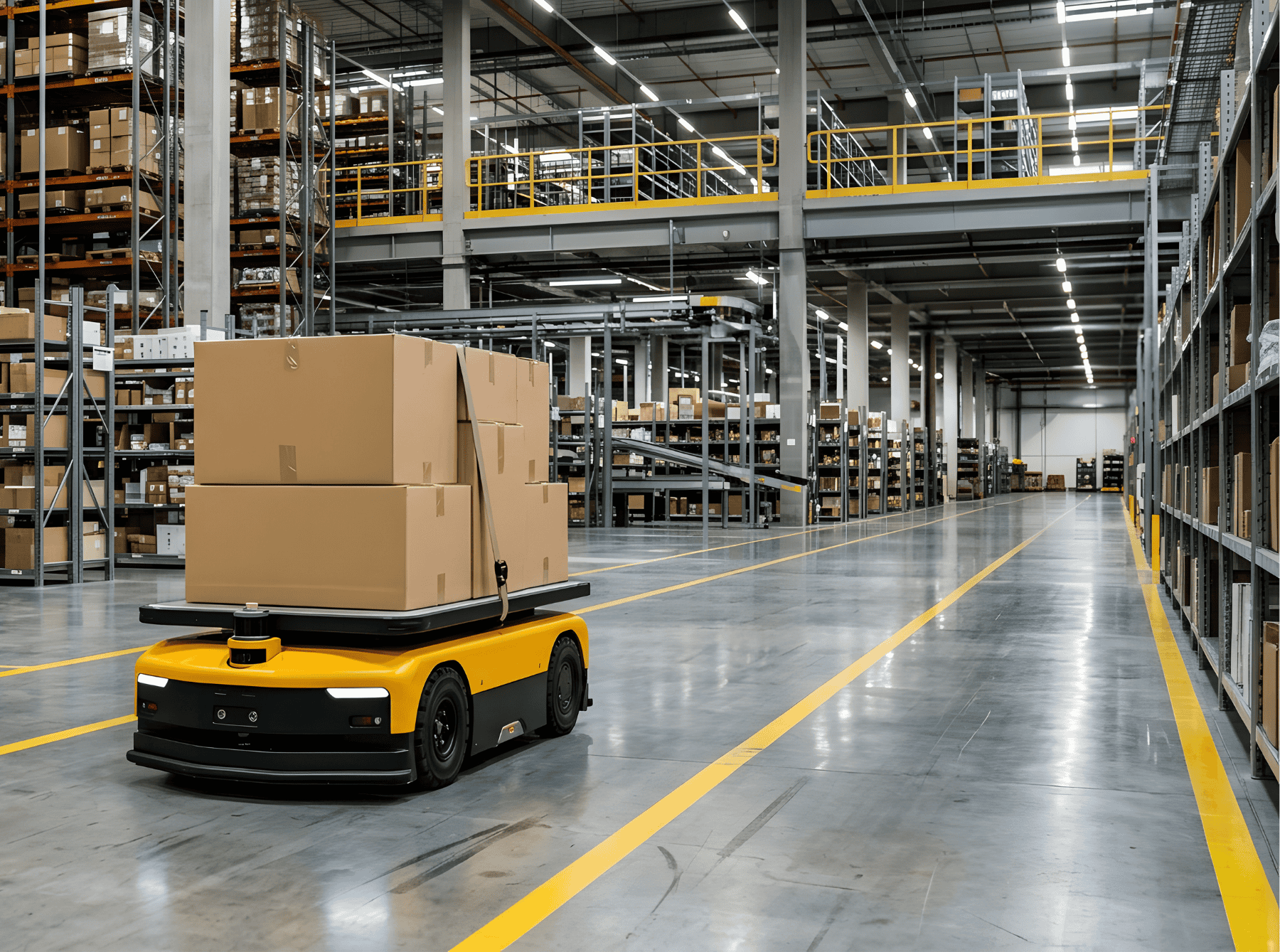
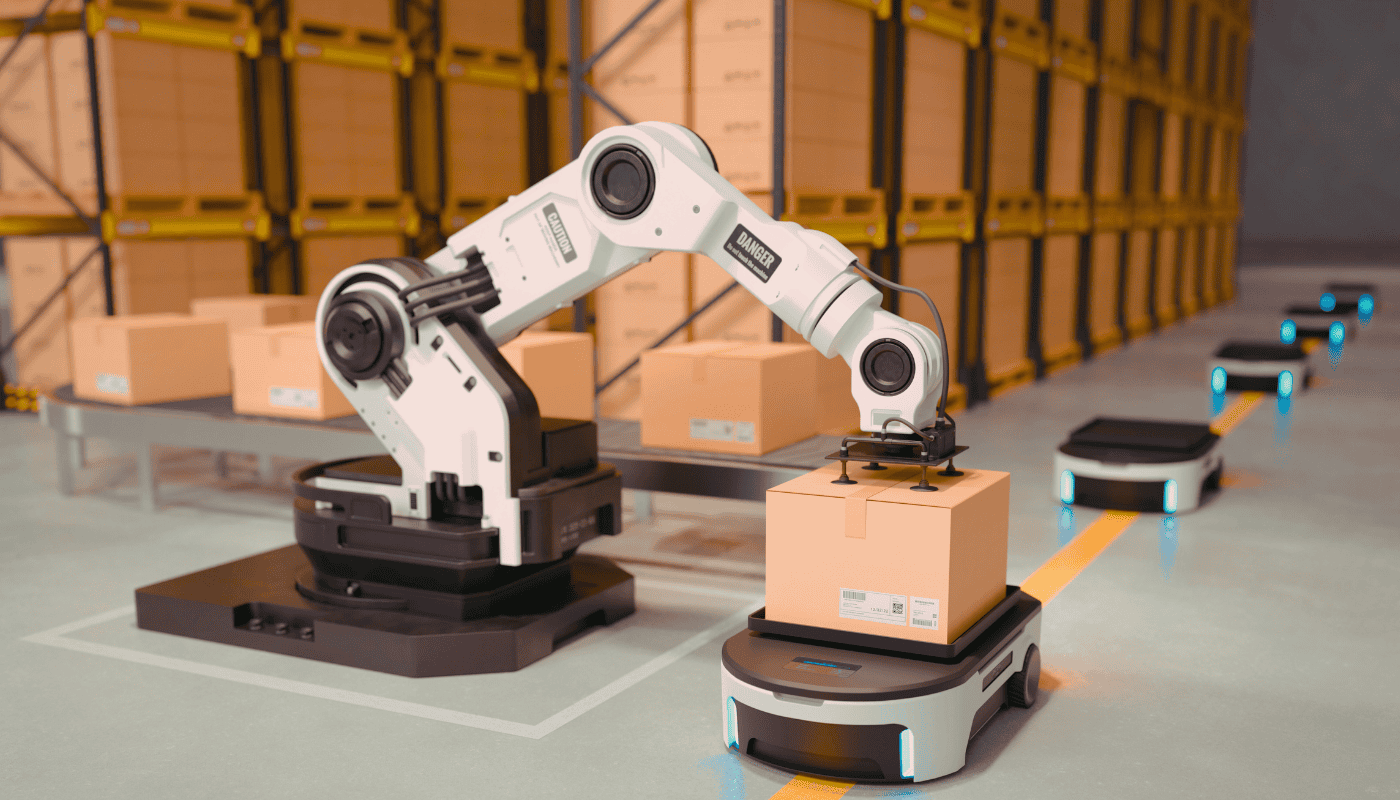
Automation is no longer a future ambition. It is a practical response to rising labour costs and ongoing recruitment challenges. In 2025, only 10–15% of global warehouses used robots, according to the UKWA’s report, but this proportion is set to rise sharply as automation costs fall and technology becomes more accessible.
As automation adoption increases, warehouse infrastructure must be designed with precision. Floor flatness, vibration control and load performance all become critical factors, particularly where autonomous mobile robots and conveyor systems operate continuously.
Hi-Level’s approach to automation-ready mezzanines reflects this reality. Structural calculations, steelwork fabrication and flooring selection are all carried out with future automation in mind, ensuring mezzanine floors can support both current operations and anticipated upgrades. This reduces the risk of costly modifications later and allows automation strategies to be phased in as budgets and business cases allow.
According to Mordor Intelligence, the warehouse robotics market is forecast to reach $21.08 billion by 2030, growing at a compound annual growth rate of 17.7%. This growth will shape how warehouses are organised, operated and designed.
How mezzanines help
Modern mezzanine floors are engineered to be automation-ready, capable of supporting conveyors, robotics and integrated handling systems. Hi-Level’s Hi-Tile robot-ready decking provides a durable, high-performance surface suited to robotic movement and automation loads, ensuring mezzanines remain fit for purpose as technology adoption increases.
4. AI-powered warehousing and data-driven layouts
Artificial intelligence is moving from competitive advantage to operational necessity. In 2026, AI-driven systems are optimising inventory management, demand forecasting and picking strategies in real time, helping warehouses improve accuracy, speed and cost control. Research shows that 94% of manufacturers in Asia-Pacific have either invested or plan to invest in AI and machine learning over the next five years.
As layouts become more data-led, flexibility in physical infrastructure becomes essential. Warehouses must be able to adapt quickly as systems evolve.
AI-driven systems also change how space is allocated. Traditional fixed layouts are giving way to more fluid configurations that respond to demand patterns, seasonal peaks and service-level requirements. Warehouses increasingly require zones that can be reassigned quickly, whether for fast-moving goods, returns processing or value-added services.
Mezzanine floors support this flexibility by creating additional layers of usable space that can be repurposed without altering the main building shell. Offices, control rooms and technical areas can be positioned above operational zones, freeing valuable ground-floor space for core logistics activity. Over time, these areas can be reconfigured or expanded as data insights reveal new operational priorities.
How mezzanines help
Bespoke mezzanine designs allow layouts to be planned around AI-enabled workflows, with space allocated for automated processes, control rooms or digital operations. Modular mezzanine systems can also be reconfigured as requirements change, protecting long-term value.
5. Sustainability, ESG and net-zero pressure
Sustainability is now a commercial consideration rather than a branding exercise. Manufacturing remains the UK’s largest emitter of greenhouse gases, followed by transport and storage. The government’s target to reach net zero by 2050 places increasing responsibility on industrial occupiers to reduce emissions.
Sustainability considerations are also influencing investment decisions from lenders, insurers and institutional investors. Buildings that demonstrate efficient use of space and a clear pathway to improved environmental performance are increasingly favoured. This places pressure on occupiers to demonstrate not only compliance, but proactive management of their estates.
By extending the usable life and capacity of existing buildings, mezzanines support a more sustainable approach to growth. Hi-Level’s value-engineered designs ensure materials are used efficiently, reducing waste during manufacture and installation. In many cases, installing a mezzanine avoids the environmental impact associated with demolition, groundworks and new construction, while still delivering the additional space required.
Proposed reforms to minimum EPC ratings, rising from E to C by 2027 and B by 2030, underline the importance of choosing buildings that can adapt over time.
How mezzanines help
By optimising existing buildings rather than constructing new ones, mezzanines reduce embodied carbon and construction waste. Hi-Level’s value-engineered approach ensures steel is used efficiently, minimising waste while maximising usable space. Future-proofing premises through vertical expansion also helps businesses avoid repeated moves as they grow.
6. Rising costs driving better use of existing buildings
Cost pressure remains a defining feature of the 2026 outlook. UK business rates are expected to rise by up to 30%, while labour costs continue to increase through minimum wage changes. At the same time, the speculative development pipeline has fallen sharply, limiting options for relocation. According to Savills, the pipeline has fallen by 65% from its peak in Q2 2022 to realign with pre-pandemic levels.
These factors are forcing occupiers to reassess how effectively they use their current footprint and underline the benefit of maximising existing space.
How mezzanines help
Installing one or more mezzanine floors allows businesses to increase capacity at a fraction of the cost of moving premises. For many, this represents a clearer return on investment, particularly where operational disruption must be kept to a minimum.
7. Warehouses getting taller, more modular and built to last
Looking ahead to 2050, the UK Warehousing Association predicts that warehouses will become larger, taller and more modular. Climate change, rising land values and planning constraints will encourage intensification and co-location, making better use of limited industrial land.
Buildings will need to accommodate changing functions over time, from storage and fulfilment to offices and digital operations.
Modularity is becoming a defining feature of modern warehouse design. Facilities are expected to accommodate changes in staffing levels, automation intensity and operational mix over time. Fixed layouts that cannot adapt risk becoming obsolete long before the end of their economic life.
Mezzanine systems designed with modularity in mind allow businesses to add, remove or reconfigure floors as requirements change. Additional staircases, goods lifts or safety features can be introduced when needed, ensuring compliance and usability are maintained throughout the building’s lifecycle. This approach aligns closely with the UKWA’s vision of warehouses that are built to last, yet flexible enough to evolve.
How mezzanines help
Mezzanines provide the structural flexibility required to adapt layouts over time. Modular designs allow additional floors, offices or storage zones to be introduced as needs change, supporting long-term operational resilience without structural compromise.

8. Cyber security and digital resilience in logistics estates
As warehouses become increasingly digital, cyber security risks are rising. Attackers are now using AI to exploit vulnerabilities faster and at greater scale. IBM’s Cost of Data Breach Report 2025 found that retail businesses faced average losses of $3.54 million per breach.
Physical infrastructure plays a role in managing these risks.
How mezzanines help
Mezzanine floors can be used to physically separate sensitive systems, server rooms and digital operations from core warehouse activity. This segregation supports layered security strategies while maintaining operational efficiency.
9. Visibility, resilience and adaptability under uncertainty
Geopolitical disruption, tariffs and extreme weather events are placing additional stress on global logistics systems. According to Maersk Contract Logistics, businesses remain concerned about how ongoing uncertainty will affect supplier bases and warehousing footprints. In this environment, visibility and adaptability are critical. Other research reveals that 74% of logistics property occupiers in Asia-Pacific expect economic uncertainty to be a major challenge in the next two years.
Resilience is increasingly defined by how quickly a business can respond to disruption. Whether caused by geopolitical events such as US intervention in Venezuela and ambitions to seize Greenland, weather-related incidents or supplier failure, the ability to adjust stockholding, reroute flows or create temporary buffer zones can make a critical difference.
Mezzanines provide physical capacity that supports this adaptability. Additional storage levels allow businesses to hold contingency stock closer to customers, while segregated areas can be designated for specific product lines or customers during periods of disruption. This physical flexibility complements digital visibility tools, creating a more resilient overall operation.
How mezzanines help
By increasing usable space within existing buildings, mezzanines give businesses greater flexibility to hold buffer stock, reorganise flows and respond quickly to change. This adaptability supports resilience without locking organisations into inflexible long-term commitments.
10. The rapid expansion of the UK self-storage sector
One of the most promising sectors for 2026 is self-storage. The UK market now generates over £1 billion in annual turnover, supported by Britain’s 60 million e-commerce users and growing demand for flexible storage solutions.
According to Cushman & Wakefield, 44% of self-storage operators are planning further investment in new sites. With facilities typically offering generous headroom, mezzanines present an opportunity to increase capacity dramatically.
How mezzanines help
Self-storage operators can gain three or four times the usable space by installing mezzanines. Hi-Level client Space Station, for example, installed four mezzanine floors at its Doncaster site, quadrupling its square footage.
Larger units are typically located at ground level, with mezzanines carrying smaller, lighter units above. Hi-Level’s structural engineers calculate precise loadings for every project, ensuring safety and compliance while tailoring layouts to customer profiles, whether residential or B2B-led.
Expert insight
Chris Baxter, Sales Director of Hi-Level Mezzanines, comments:
“Looking ahead to 2026, we expect significant growth driven by e-commerce and last-mile logistics, where space efficiency and speed are everything. Our bespoke, automation-ready mezzanine systems position us well to support customers as they expand and adapt in this rapidly evolving landscape.”
Beyond individual trends, a common theme emerges across the 2026 outlook: the need to make smarter use of what already exists. Rising land values, planning constraints and cost pressures mean that expansion is no longer simply a question of finding a bigger building.
Hi-Level Mezzanines’ turnkey approach supports this shift. By managing design, structural engineering, manufacturing and installation in-house, projects can be delivered efficiently and with minimal disruption to live operations. Dedicated project management ensures coordination with other building services such as lighting, fire protection and automation infrastructure, reducing risk and simplifying delivery for clients.
For large-scale warehousing and logistics operations, this level of control and accountability is increasingly important. It allows decision-makers to plan with confidence, knowing that additional capacity can be delivered safely, compliantly and in line with long-term operational goals.
As warehousing and logistics trends for 2026 continue to reshape the sector, making better use of existing space has become a strategic priority. Hi-Level Mezzanines works with businesses across the UK to design and deliver bespoke, future-ready mezzanine solutions that support growth, automation and long-term value.
Speak to Hi-Level today to explore how a mezzanine could support your next phase of growth.
-
Yes, when designed properly. Hi-Level Mezzanine’s qualified structural engineers design mezzanine floors to integrate with automation systems such as robotics, conveyors and sortation equipment.
Our revolutionary Hi-Tile flooring is specifically designed for heavy-duty performance, making it ideal for automated operations.
The key is ensuring the mezzanine can support dynamic loads, vibration, frequent movement, load cycles, concentrated loads and integration with conveyors or robotics.
When specifying a mezzanine for automation, Hi-Level Mezzanines will:
- Determine exact load per square metre and concentrated load scenarios
- Use robust flooring such as Hi-Tile that resists wear and deformation
- Provide vibration control if required
- Ensure foundations, bracing and stiffness meet strict engineering tolerances.
- Planning and Installation
- Sectors and Applications
-
Mezzanine floors are used to optimise vertical space in warehouses, logistics hubs, factories, retail outlets, offices and self-storage facilities. They can support storage, picking operations, production lines, office space or customer areas.
Mezzanine floors are highly versatile. They can be used for:
- Storage and warehousing — adding shelving, pallet racking and storage platforms to increase capacity
- Production / manufacturing — creating additional workspace inside an existing facility
- Automated systems / robotics / conveyors — integrating automation infrastructure on or under the mezzanine
- Office / welfare space — adding offices, meeting rooms, a canteen or rest areas above ground level
- Retail / display / self-storage — retail showrooms, display floors or self-storage units.
An example is how our four-tier solution to optimise Space Station’s new self-storage facility in Doncaster demonstrates how mezzanines maximise vertical space in this sector.
- Sectors and Applications
-
Clear headroom is needed both above and below. Typically, 2.0–2.4m clearance is required, depending on use. Hi-Level Mezzanines advises on exact requirements during survey and design. Some typical guidance:
- A minimum clear height under the mezzanine of 2.0m is often required, sometimes more if forklift or pallet truck access is needed beneath
- Clearance above the mezzanine also should allow safe access, maybe 2.0-2.5m depending on ceiling height, lighting, services etc.
- If used for offices or welfare space, there may also be minimum ceiling height requirements (often 2.4m or more in office partitions).
- Building Regulations and Compliance
- Planning and Installation