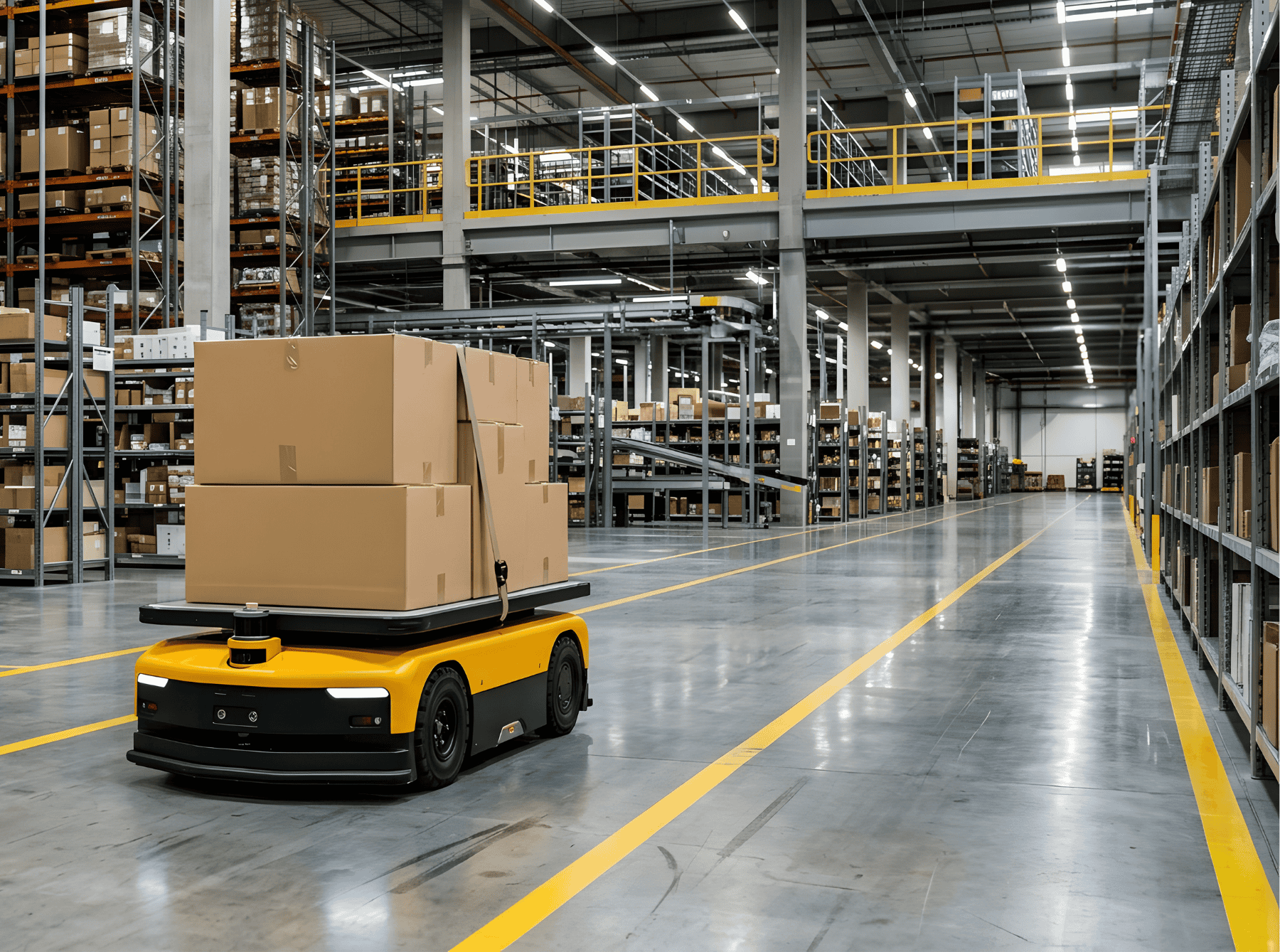
Robotics is now a core part of warehouse and logistics strategy in the UK. Automated systems are being adopted not as an experiment, but as a long-term response to labour shortages, rising operational costs and the need to process higher order volumes with greater accuracy. As robotics activity increases, so does the importance of the infrastructure that supports it – particularly the floor.
This robot flooring guide for the UK explains why robotics demands specialist flooring, how robot movement affects floor performance over time and what decision-makers should consider when specifying flooring for automated environments. It also explains how Hi-Tile, Hi-Level Mezzanines’ robot-ready flooring system, addresses these challenges in live UK installations.
Why robotics is booming in UK warehouses and logistics
Warehouse automation in the UK has shifted from optional to expected. Persistent recruitment challenges, increasing wage pressure and rising customer expectations are pushing operators to rethink how goods move through their facilities.
Industry forecasts underline the scale of this change. A 2025 report in ecommercenews.uk noted that over 85% of UK fulfilment warehouses are expected to be automated by 2030 due to advances in Artificial Intelligence (AI) and robotics.
Major UK operators such as Ocado, John Lewis and GXO Logistics have already demonstrated how robotics can improve throughput, accuracy and space efficiency while allowing staff to move into higher-value roles. For many businesses, robotics is no longer about replacing people but about maintaining service levels when labour availability is unpredictable.
Organisations are increasingly considering robotics when:
- staff turnover or recruitment gaps restrict capacity
- warehouse space is under-used vertically
- manual processes introduce delays or errors
- order volumes fluctuate sharply during peak periods.
As robotics becomes embedded into day-to-day operations, the performance of the warehouse floor becomes a critical factor rather than a background consideration.
Four key robotics used in UK warehouses
Understanding how different robotic systems operate is essential when assessing automated warehouse flooring requirements. Each system interacts with the floor in different ways and places different demands on surface performance.
Autonomous mobile robots (AMRs)
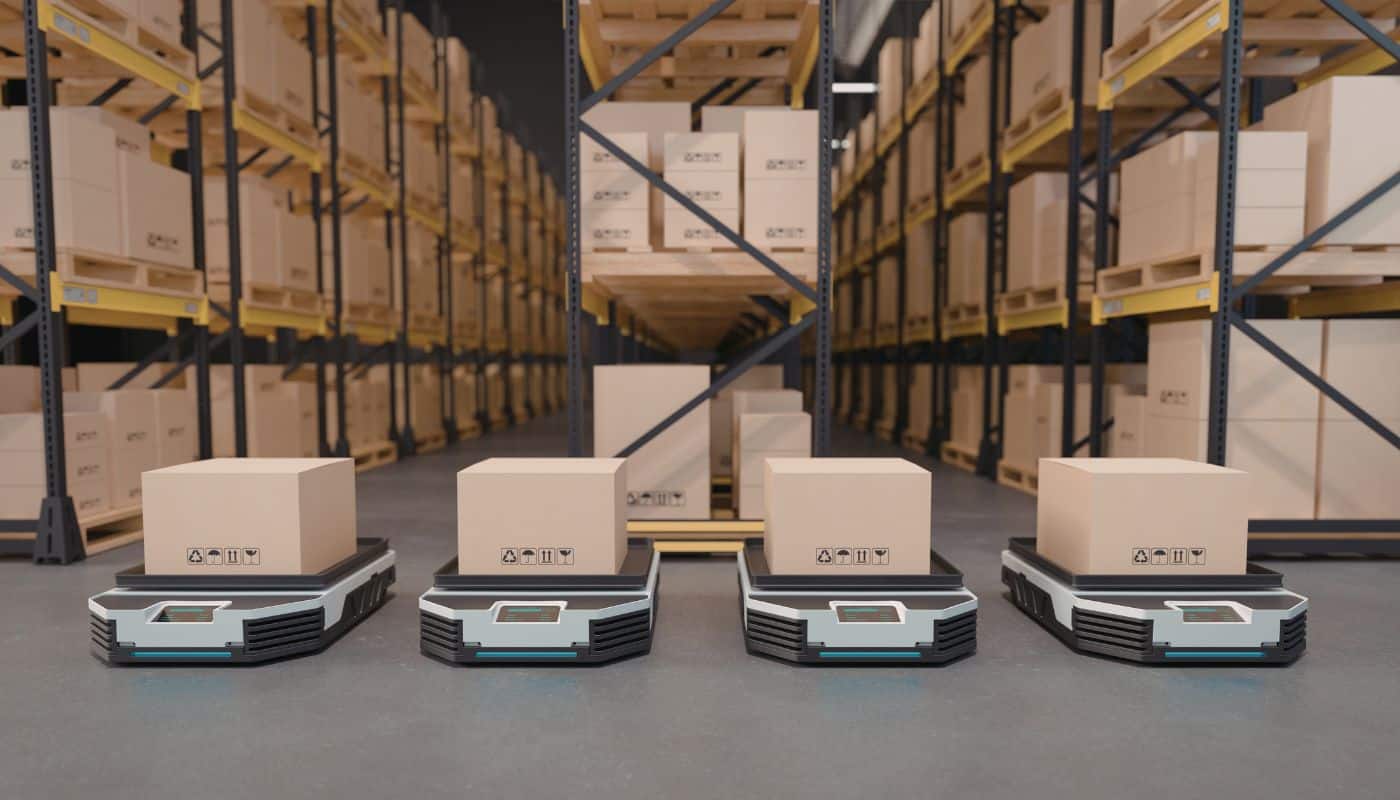
Autonomous mobile robots navigate dynamically using sensors, AI and machine learning rather than following fixed routes. They are widely used for goods-to-person picking, internal transport and repetitive tasks that are dull, dirty or hazardous.
AMRs reduce wasted walking time, improve picking accuracy and can be deployed quickly without major infrastructure changes. Their flexibility makes them popular in UK warehouses dealing with seasonal demand or labour shortages. However, this same flexibility means they travel extensively across the floor surface, often following optimised routes that concentrate wear in specific areas.
Automated guided vehicles (AGVs)
AGVs follow predefined routes using physical guides such as wires or magnetic markers. Although more established than AMRs, they still place consistent demands on floor flatness, surface condition and friction levels, particularly where routes are heavily trafficked.
Automated storage and retrieval systems (AS/RS)
AS/RS solutions use computer-controlled systems to store and retrieve goods from defined locations. Modern cube-based systems maximise vertical space by stacking storage units densely and retrieving items using robots that move across a grid.
These systems benefit from installing mezzanines to fully exploit building height. They also rely on highly consistent floor conditions to ensure smooth robot movement, accurate positioning and reliable operation over long periods.
Robotic picking and packing systems
Robotic picking systems use vision technology and intelligent gripping mechanisms to identify and handle products. They are particularly suited to ecommerce operations with large product ranges and fluctuating volumes.
While these robots may be stationary, they depend on surrounding robotic transport systems and stable floor conditions to maintain alignment, speed and accuracy.
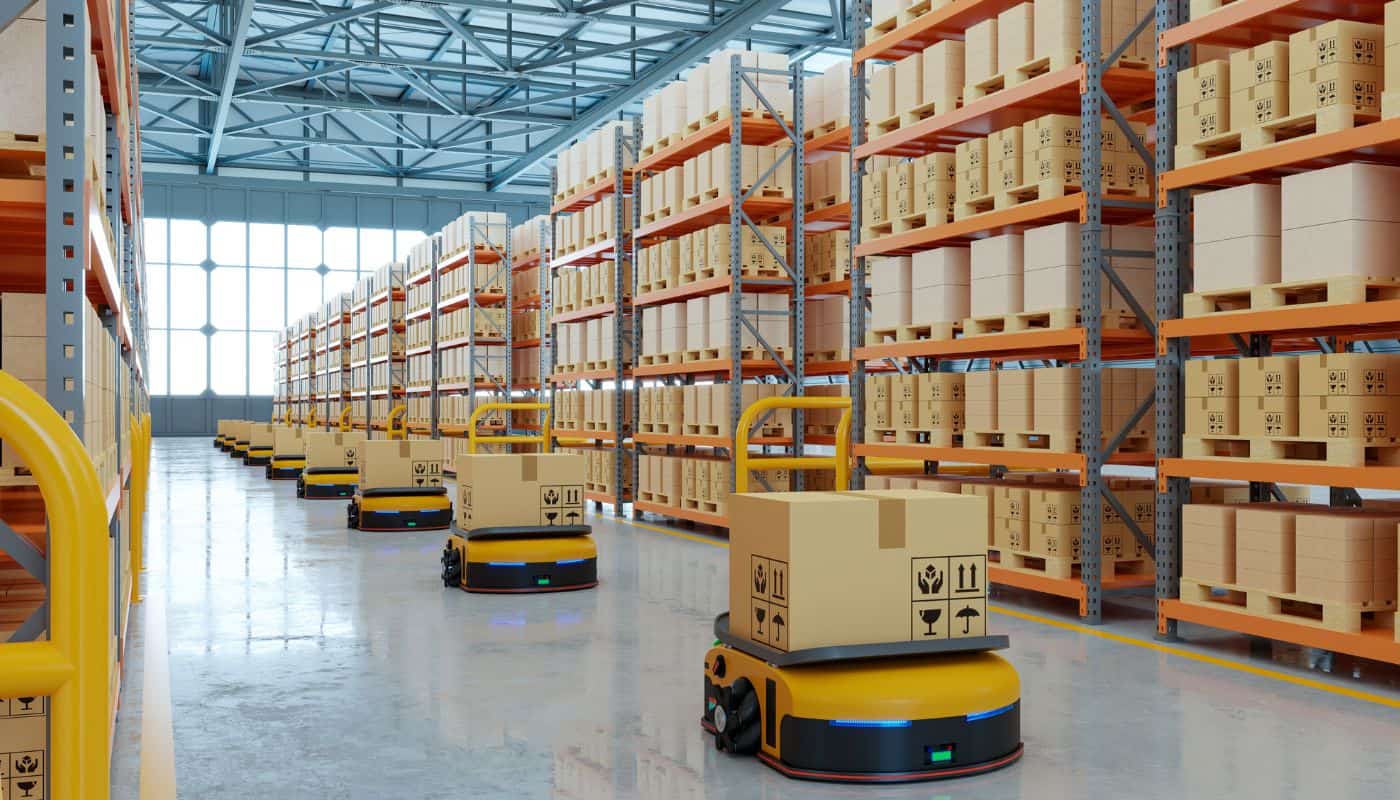
Why robotics needs specific flooring
Traditional warehouse floors were designed for people, pallet trucks and forklifts. Robotics changes that equation.
Robots operate continuously, follow repeatable paths and rely on precise sensor feedback. Even minor variations in surface flatness, roughness or reflectivity can affect navigation accuracy, speed and wear rates. Over time, small inefficiencies compound into reduced throughput and increased maintenance.
This is why robot-ready flooring is now recognised as a distinct specification rather than an afterthought. Flooring must support predictable robot movement, minimise disruption and remain stable under sustained, repetitive use.
Flooring for robotics provides consistent friction, flatness and durability, helping automation perform as intended over its full lifecycle.
How robot travel affects floor wear and tear
One of the most overlooked aspects of robotics deployment is the cumulative impact of robot travel on flooring.
In large logistics facilities, some AMR fleets record over 1,200 miles of travel per day, completing thousands of missions across the warehouse. Even smaller fleets can generate thousands of robot-miles per week, particularly when operating across multiple shifts.
This level of activity creates concentrated wear patterns:
- repetitive wheel rolling causes micro-abrasion
- joints and uneven areas experience higher stress
- polished or degraded surfaces alter friction levels
- robots compensate for surface inconsistencies, increasing travel distance and wear.
High-traffic corridors, docking points and charging areas are especially vulnerable. Without suitable flooring, these zones can deteriorate rapidly, leading to inconsistent robot performance and increased maintenance demands.
Problems a poor floor can cause in robotic environments
Inadequate flooring can undermine the benefits robotics is intended to deliver. Common issues include:
Lower productivity and interrupted workflows
Uneven or damaged floors slow robot travel, extend task times and reduce overall throughput, particularly in high-traffic areas.
Navigation faults and unplanned stoppages
Inconsistent surfaces can disrupt sensors and guidance systems, causing robots to pause, reroute or require manual intervention.
Higher risk, wear and maintenance demand
Poor flooring increases the likelihood of instability, collisions and damaged goods, while accelerating wear on robot wheels and components and driving up maintenance costs.
The case for specialist flooring for robotics
Given the scale and intensity of robotic activity, specialist flooring offers clear advantages.
Robot-ready flooring is designed to:
- maintain consistent friction across large areas
- minimise surface variation and joints
- resist abrasion under high traffic volumes
- support predictable robot movement
- allow targeted maintenance without widespread disruption.
These characteristics reduce unplanned downtime, improve robot efficiency and protect long-term investment in automation.
How flooring affects robot accuracy and speed
Flooring directly influences how accurately and efficiently robots move.
Inconsistent friction can cause wheel slip or hesitation. Surface roughness increases vibration, affecting sensors and slowing travel speeds. Variations in reflectivity can interfere with optical or downward-facing sensors.
When flooring is consistent and predictable, robots maintain higher average speeds, follow planned routes more accurately and complete missions with fewer corrections. Over time, this improves throughput and reduces wear on robot components.
What must be considered when installing flooring for robotics
Choosing the right flooring for robotics in the UK requires careful consideration of several factors.
Structural performance and durability
Flooring must carry robot and payload loads without movement or damage, while withstanding continuous, high-frequency traffic far beyond that of manual operations.
Consistent movement and sensor reliability
A flat, smooth surface with controlled grip and reflectivity supports stable wheel contact, accurate navigation and dependable sensor performance, even in dusty working environments.
Long-term usability and maintenance
Robotic flooring should allow localised repairs or replacements in high-wear areas without causing disruption or extended shutdowns across the operation.
How flat does a floor need to be for AMRs?
AMRs require a much higher level of floor flatness than traditional manual operations. Even small variations in level can affect wheel contact, sensor readings and navigation accuracy.
While exact tolerances depend on the robot manufacturer, AMRs typically perform best on floors with minimal deviation, consistent surface quality and controlled joints. Uneven concrete slabs, worn coatings or poorly finished deck panels can cause robots to slow down, recalibrate frequently or take longer routes, reducing overall efficiency.
Hi-Tile from Hi-Level Mezzanines
Hi-Tile is Hi-Level Mezzanines’ robot-ready flooring system, developed to meet the demands of modern automated environments.
It uses interlocking 7mm textured PVC tiles to create a durable, consistent surface suitable for robotics. Hi-Tile can be installed on new mezzanines, retrofitted onto existing structures or used as part of wider commercial infrastructure upgrades.
Key characteristics include:
- electrostatic resistance
- anti-slip surface
- high durability under repetitive traffic
- moisture resistance
- minimal subfloor preparation
- immediate usability after installation
- 10-year wearability warranty
- replaceable individual tiles
- recyclable PVC construction
Unlike epoxy coatings or steel plates, Hi-Tile avoids cracking, blistering and extended curing times. Its modular design allows targeted replacement in high-traffic areas without widespread disruption.
Hi-Tile has been tested extensively, including high-cycle trials with heavy payloads, and is in demand from a range of clients as well as leading robotics providers.
Can existing mezzanines be upgraded for robotics?
Yes, many existing mezzanines can be upgraded to support robotics without replacing the entire structure.
Upgrades often focus on:
- installing a robot-ready floor surface over existing decking
- improving flatness and consistency
- ensuring load capacity matches robot and payload requirements
- addressing high-traffic robot routes and docking areas.
Modular flooring systems are particularly useful for retrofits, as they can be installed with minimal disruption and allow targeted improvements where robots operate most frequently.
Hi-Tile in use: real-world examples
Wayland Games: robot-ready mezzanine flooring
Wayland Games, Europe’s largest independent tabletop games retailer, required a new warehouse to support rapid growth. From the outset, robotics and space optimisation were central to the project.
Hi-Level designed and installed a large single-tier mezzanine incorporating Hi-Tile robot-ready flooring to support an AMR-based goods-to-person system. The flooring provides a stable, consistent surface for robot travel while allowing manufacturing, assembly and bulk storage below.
Testimonial
“The knowledge Hi-Level demonstrated during the design process was second-to-none and made them the clear choice when deciding on a mezzanine floor supplier. We are extremely pleased with the solution provided.”
Facilities Project Manager, Wayland Games
Health and beauty retailer: e-fulfilment robotics upgrade
A major international health and beauty retailer upgraded its e-fulfilment centre to introduce AMRs on an existing mezzanine. The project required a flooring solution that could be installed quickly and perform reliably under heavy robotic traffic.
Hi-Tile was selected for its availability, durability and ability to replace individual tiles if required. More than a year after installation, with over 90 robots operating continuously, the flooring continues to perform without a single tile replacement.
Testimonial
“We are very pleased with how the Hi-Tile flooring is performing and are confident that our decision to opt for this solution will continue to be successful.
Project Coordinator, Supply Chain Development
Planning maintenance for robotic floors
Robotic floors should be maintained proactively rather than reactively.
Good maintenance planning includes:
- regular inspection of high-traffic robot routes
- monitoring wear around charging stations and transfer points
- localised replacement or repair of damaged areas
- keeping surfaces clean to maintain consistent friction and sensor performance.
Flooring systems that allow individual sections or tiles to be replaced make maintenance faster, less disruptive and more cost-effective than large-scale repairs or recoating.
Robotics delivers measurable benefits only when supported by the right infrastructure. Flooring plays a central role in reliability, efficiency and long-term performance. For UK operators planning or expanding automation, understanding flooring requirements is no longer optional.
Hi-Level Mezzanines combines mezzanine expertise with robot-ready flooring solutions designed for real operational demands. To discuss how your facility can be prepared for robotics now and in the future, speak to the Hi-Level team.
-
Yes, when designed properly. Hi-Level Mezzanine’s qualified structural engineers design mezzanine floors to integrate with automation systems such as robotics, conveyors and sortation equipment.
Our revolutionary Hi-Tile flooring is specifically designed for heavy-duty performance, making it ideal for automated operations.
The key is ensuring the mezzanine can support dynamic loads, vibration, frequent movement, load cycles, concentrated loads and integration with conveyors or robotics.
When specifying a mezzanine for automation, Hi-Level Mezzanines will:
- Determine exact load per square metre and concentrated load scenarios
- Use robust flooring such as Hi-Tile that resists wear and deformation
- Provide vibration control if required
- Ensure foundations, bracing and stiffness meet strict engineering tolerances.
- Planning and Installation
- Sectors and Applications
-
Mezzanine floors are used to optimise vertical space in warehouses, logistics hubs, factories, retail outlets, offices and self-storage facilities. They can support storage, picking operations, production lines, office space or customer areas.
Mezzanine floors are highly versatile. They can be used for:
- Storage and warehousing — adding shelving, pallet racking and storage platforms to increase capacity
- Production / manufacturing — creating additional workspace inside an existing facility
- Automated systems / robotics / conveyors — integrating automation infrastructure on or under the mezzanine
- Office / welfare space — adding offices, meeting rooms, a canteen or rest areas above ground level
- Retail / display / self-storage — retail showrooms, display floors or self-storage units.
An example is how our four-tier solution to optimise Space Station’s new self-storage facility in Doncaster demonstrates how mezzanines maximise vertical space in this sector.
- Sectors and Applications
-
Load capacity varies on design and use. Mezzanines can be engineered for light storage, offices or heavy automation. Hi-Level Mezzanines’ qualified structural engineers calculate loadings precisely to match client needs.
Factors we consider:
- Uniform loads (e.g. storage shelves evenly distributed) versus point or concentrated loads (e.g. heavy machinery, robotics footings)
- Dynamic loads (movement, vibration)
- Floor vibrations, deflection limits.
In robotics and automation projects, the loading per square metre will often be high, and the decking chosen (such as our robot-ready Hi-Tile) must handle heavy, frequent loads without deformation or failure.
- Building Regulations and Compliance
- Planning and Installation
- Sectors and Applications
- Structural Design