Mezzanine design for Industry 4.0 and Industry 5.0 is becoming a defining factor in how warehouses and manufacturing facilities are planned across the UK. As automation, robotics and smart systems become standard, mezzanine floors are no longer simply a way to increase space – they are central to how operations function.
Government-backed investment is accelerating this shift. From 2026, £99 million has been committed to expanding the Made Smarter Adoption programme, helping UK manufacturers adopt digital technologies and improve productivity.
For businesses upgrading their facilities, this raises an important question: how do you design a mezzanine that supports today’s automation while remaining adaptable for what comes next?
What is Industry 4.0?
Industry 4.0 describes the integration of digital technologies into industrial environments. This includes automation, robotics, IoT systems and data-driven decision-making.
In practice, warehouses are becoming more intelligent and responsive. Robots equipped with advanced sensors capture real-time data across operations, which is then analysed using artificial intelligence to improve visibility, forecasting and efficiency.
This level of integration is now expected. As automation expert Dr Daniela Sawyer explains in Logistics Manager magazine: “The current expectation is that every piece of work we do will have a digital integration aspect to it… everyone wants smart machines that can generate data from their processes and that data wants to be centralised and made available to decision makers in a digestible format.”
At the same time, adoption is still growing. The UK’s robot density remains below the global average of 162 units per 10,000 employees, while the number of industrial robots in use worldwide continues to rise year on year.
This indicates significant potential for further automation – and a growing need for infrastructure that can support it.

How Industry 4.0 is shaping mezzanine design
Designing for automation and robotics
Automation is no longer an optional upgrade. It is becoming a core requirement across warehousing, logistics and manufacturing.
Mezzanine floors must now support:
- Conveyor systems linking multiple operational levels
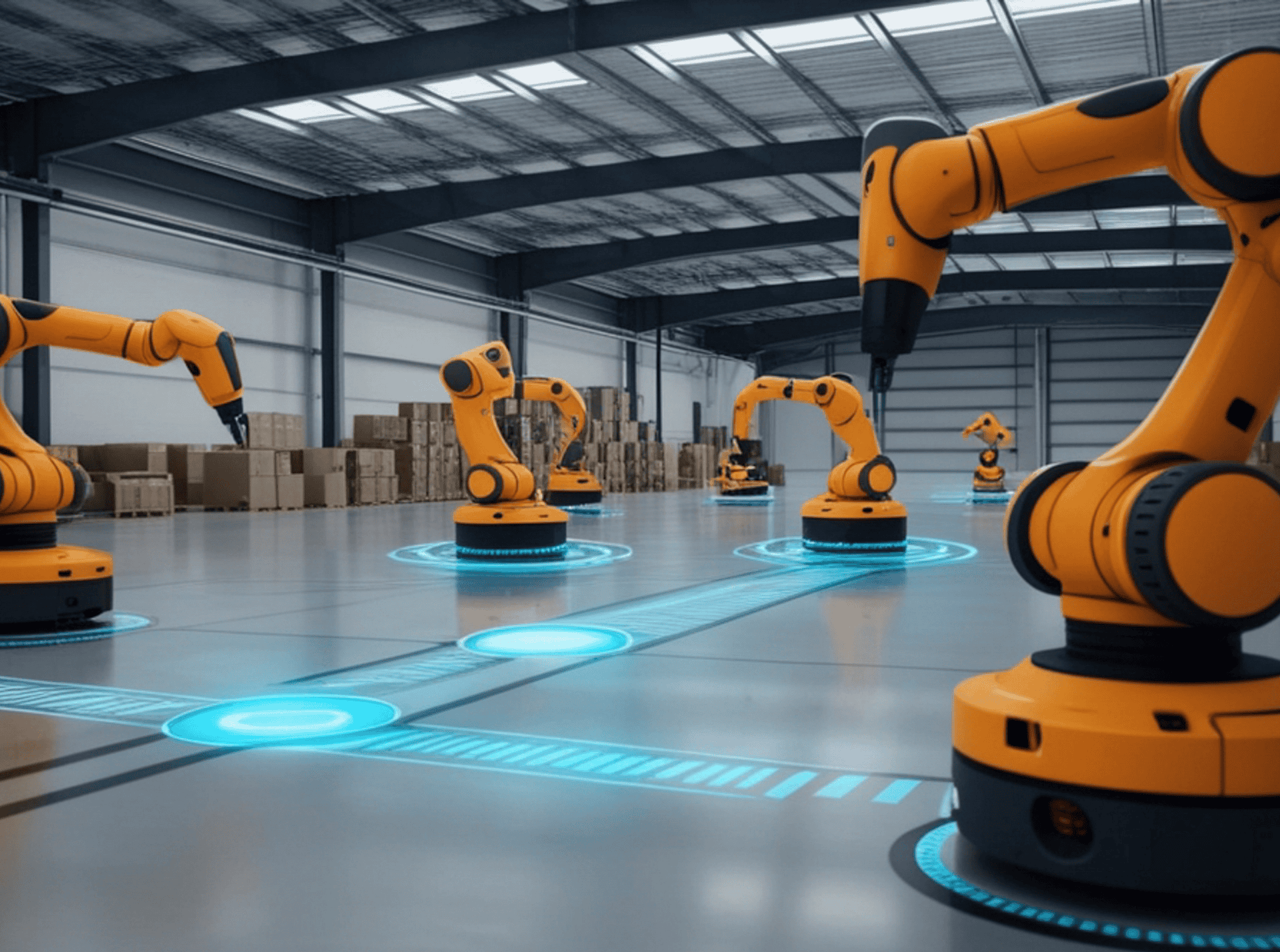
- Robotic picking, packing and sorting systems
- Automated storage and retrieval solutions.
These systems rely on precise structural engineering. Flooring must withstand constant movement, while layouts must allow efficient flow between processes.
Mezzanines are particularly effective in robotics environments, where separating tasks across levels improves productivity while maintaining connectivity.
Responding to supply chain complexity
Modern supply chains are more unpredictable than ever. Global events and energy demands have highlighted how vulnerable operations can be.
Industry 4.0 technologies help address this by improving visibility and forecasting. Real-time data and predictive analysis allow businesses to respond faster to disruption and plan with greater confidence.
Mezzanine design plays a supporting role by enabling:
- Clear, structured workflows
- Dedicated zones for different operations
- Improved movement of goods across facilities.
Maximising space in high-demand environments
The UK manufacturing sector remains globally significant, ranked 11th with an output of $279 billion.
With demand high and space limited, businesses need to make better use of existing buildings.
Mezzanines provide a practical solution by:
- Expanding usable space without relocation
- Supporting multi-level operations
- Reducing congestion at ground level.
This is particularly valuable in logistics and e-commerce, where throughput and speed are critical.
Supporting workforce development
Automation does not remove the need for people – it changes how they work.
Technology is increasingly used to upskill employees, moving them into more strategic, value-added roles while repetitive tasks are handled by machines.
Mezzanine layouts must reflect this shift by creating environments where both automated systems and skilled workers can operate effectively.
Designing for flexibility and future expansion
One of the most important aspects of modern mezzanine design is future-proofing. This includes:
- Designing single-tier structures that can later be expanded
- Allowing for additional floors to be added
- Ensuring load capacity supports future equipment.
A mezzanine installed today should be able to evolve alongside the business, avoiding the need for major structural changes later.
Future-proofing mezzanine design for Industry 4.0
To support ongoing technological change, mezzanines should be designed with:
Built-in scalability: structures that can grow in height or footprint as operations expand.
Automation readiness: compatibility with conveyors, robotics and smart systems.
Integrated workflows: layouts that reduce bottlenecks and improve efficiency.
Strong engineering foundations: accurate calculations and high-quality materials to support long-term use.
Hi-Level Mezzanines delivers this through a fully integrated approach, combining design, manufacturing and installation to create tailored solutions for complex environments.
Government support for smarter business
The £99m Government commitment into the Made Smarter Adoption programme specifically targets SMEs with grants and digital internships.
As the Made Smarter website sets out, manufacturers can “uncover the technologies and tools that will grow your business and receive tailored support at any stage of your digital journey. Are you a manufacturer looking to accelerate the growth of your business but struggling to understand the best route forward? We can support you with: Impartial advice from a team of digital specialists; creating a digital roadmap for your business; enhancing your digital skills with Leadership & Skills training; funding to support the purchase of hardware and software.”
How Industry 5.0 will influence mezzanine design
Human-in-the-loop operations
A key concept in Industry 5.0 is the “human-in-the-loop” model.
Autonomous robots handle repetitive tasks and collect data, while people make decisions, prioritise work and manage exceptions.
This requires mezzanine layouts that support both automated systems and human oversight.
Designing for human-robot interaction
As Logistics Manager explains: “Warehouses are getting smarter, faster and more automated but the most important design shift is not mechanical. It is behavioural.”
The focus is now on how people and machines interact. Effective mezzanine design should ensure that:
- Robot movements are predictable
- Signals and data are easy to understand
- Workers can respond quickly when needed.
Trust is essential. If people do not understand what automated systems are doing, it becomes harder to rely on them and scale their use.
Creating environments that work for people
Industry 5.0 recognises that efficiency alone is not enough.
Workers need space, clarity and control. Mezzanines help by:
- Maximising available space so teams can work comfortably
- Creating structured environments that reduce confusion
- Supporting a balance between manual and automated tasks.
Efficiency matters, but so does the human experience of the job – and mezzanines play an important role in delivering both.
Managing risk through balance
Fully automated systems can introduce new risks if not properly understood or managed.
Operating a mixed human and robot environment helps minimise failure points, combining the strengths of both. Robots excel at repetition and data collection. People bring judgement, accountability and adaptability.
Mezzanine design must support this balance.
Why mezzanines are essential for modern warehouses
Mezzanine floors remain a practical and strategic investment because they:
- Increase capacity without the need for new premises
- Support automation and digital integration
- Provide flexibility for future changes
- Improve both operational performance and working conditions.
For large-scale operations, they are a key part of long-term planning.
Design priorities
Industry 4.0 is reshaping how warehouses operate, driving the need for mezzanines that support automation, data integration and rapid change.
At the same time, Industry 5.0 is bringing a renewed focus on people, ensuring that technology enhances rather than replaces human capability.
For businesses investing in mezzanine floors, the priority is clear: design with both in mind.
Rising energy costs, supply chain disruption and the need for efficiency
Alongside the technological shift driven by Industry 4.0, businesses are also facing growing external pressures that are reshaping how warehouses operate. One of the most immediate challenges is the impact of global supply chain disruption and rising energy costs.
The ongoing conflict in Iran is a clear example of how quickly conditions can change. Disruption to key trade routes such as the Strait of Hormuz – through which around 20% of the world’s oil passes – has created volatility across global energy markets and logistics networks.
For UK businesses, the effects are already being felt. Energy prices have risen sharply, contributing to inflation and increasing operational costs across manufacturing and logistics. At the same time, supply chains are under strain, with longer lead times, higher transport costs and reduced reliability becoming more common.
Recent data shows that UK manufacturers are experiencing some of the fastest cost increases in decades, driven largely by energy price rises linked to the conflict.
This creates a difficult environment for warehouse operators. Facilities that were once designed purely for storage must now support faster throughput, tighter margins and greater operational resilience.
In this context, mezzanine design becomes even more important.
Driving efficiency to offset rising costs
When energy costs rise, efficiency becomes critical. Every movement, process and square metre of space must be working as effectively as possible.
Mezzanines support this by:
- Reducing the need for warehouse expansion or relocation
- Improving workflow efficiency across multiple levels
- Minimising wasted space within existing buildings
- Supporting automation that reduces energy-intensive manual processes.
By making better use of vertical space, businesses can increase output without increasing their footprint – helping to control both capital expenditure and ongoing energy use.
Strengthening resilience in uncertain supply chains
Supply chain disruption is no longer a short-term issue. Businesses are now planning for ongoing uncertainty, including fluctuating demand, transport delays and material shortages.
Mezzanine floors contribute to resilience by:
- Allowing flexible storage and operational zones
- Supporting buffer stock strategies without requiring additional premises
- Enabling faster reconfiguration of workflows as demand changes.
As research shows, supply chain disruption can increase operational costs significantly, with many companies expecting a substantial rise in cost-to-serve during periods of instability.
A well-designed mezzanine gives businesses the ability to adapt quickly, without major structural changes.
Aligning operational efficiency with Industry 4.0
There is a clear link between these economic pressures and the adoption of Industry 4.0 technologies.
Automation, robotics and data-driven systems are not only about improving productivity – they are also essential tools for managing rising costs and uncertainty.
For example:
- Real-time data helps identify inefficiencies and reduce waste
- Automated systems improve accuracy and reduce rework
- Predictive analytics supports better inventory management.
When combined with a well-planned mezzanine structure, these technologies create an environment where space, energy and labour are used more efficiently.
Preparing for a more demanding operating environment
The current landscape highlights an important point: warehouse design can no longer be static.
Facilities must be designed to handle:
- Higher energy costs
- Ongoing supply chain disruption
- Increasing demand for speed and accuracy
- Greater reliance on automation and data.
Mezzanines play a central role in meeting these demands, providing the flexibility and capacity needed to operate effectively under pressure.
Talk to us today about how we can help future-proof your business.