If you’re planning a mezzanine floor installation in a warehouse, retail premises or factory, one of the most important structural factors to understand is mezzanine loads.
Mezzanine load ratings determine how much weight a mezzanine floor can safely support. These loads influence every part of the structural design, including the supporting steel frame, decking system and column spacing.
Whether the mezzanine is used for warehouse storage, office space, manufacturing equipment or automation systems, understanding mezzanine loads is essential to ensure the structure is safe, compliant and future-proofed.
How much weight can a mezzanine floor hold?
In this guide, we explain everything you need to know about mezzanine loads, including:
- What mezzanine loads are
- The difference between live loads, dead loads and point loads
- How structural engineers calculate load capacity
- Typical load ratings for different mezzanine uses
- The risks of overloading
- Why decking and structural steel selection matter
What are mezzanine loads?
Mezzanine loads refer to the total weight that a mezzanine floor is designed to safely support during operation.
These loads include:
- People working on the floor
- Stored goods and materials
- Machinery and equipment
- Pallet racking systems
- Conveyor systems
- Building services
- The weight of the mezzanine structure itself
Structural engineers calculate mezzanine loads using recognised engineering standards and safety factors to ensure the floor can perform safely throughout its lifespan.
Because mezzanine floors are used across warehousing, logistics, manufacturing and commercial environments, the required load capacity can vary significantly depending on the intended use.

Why mezzanine load calculations matter
Accurate mezzanine load calculations are critical for three key reasons.
1.Structural safety
Incorrect load design can cause:
- Excessive deflection
- Structural fatigue
- Decking failure
- In extreme cases, structural collapse
Proper load calculations ensure the mezzanine structure remains safe under operational conditions.
2.Compliance with structural standards
Mezzanine floors must comply with recognised structural design standards and building regulations.
Hi-Level Mezzanines’ structural engineers apply factored load calculations and safety margins to ensure the structure performs safely even under unexpected loading conditions.
3.Future operational flexibility
Many warehouses and factories evolve over time.
Businesses may later introduce:
- Additional storage
- New machinery
- Conveyor systems
- Automation equipment
- Robotics systems
Designing the mezzanine with appropriate load capacity ensures it can accommodate these changes.
The seven keys to mezzanine loads
Understanding mezzanine loads involves several structural principles. These seven key factors underpin the design of safe mezzanine floors.
1. Key load definitions: live load, dead load and point load
Structural engineers use several types of loads when designing mezzanine floors.
Understanding these terms helps explain how mezzanine structures are designed.
Live load
A live load refers to the weight placed on the mezzanine during normal use.
Examples include:
- People working on the floor
- Storage pallets
- Shelving and racking systems
- Machinery or equipment
- Office furniture
- Conveyor systems
Unlike structural components, live loads can change over time, which is why Hi-Level Mezzanines structural engineers carefully assess how the space will be used.
Loads are calculated using kilonewtons per square metre (kN/m²).
For example, warehouse storage mezzanines with two metres of headroom often support loads of approximately 4.8 kN/m², allowing safe storage of pallets weighing around 500 kg.
Different operational uses will require different live load capacities.
Dead load
A dead load refers to the permanent weight of the mezzanine structure itself.
This includes:
- Structural steel beams
- Columns
- Decking materials
- Staircases
- Handrails
- Structural connections
Dead loads remain constant throughout the life of the mezzanine and must always be included in load calculations.
Point load
A point load is a load concentrated in a specific location rather than distributed evenly across the floor.
Examples include:
- Machinery feet
- Racking uprights
- Conveyor supports
- Equipment legs
Point loads are particularly important because they can place significant stress on local areas of the structure.
If point loads are not accounted for, they can lead to decking damage or structural overstress.
Engineers must ensure the mezzanine deck and structural frame can safely support these concentrated forces.
Maximum unfactored load
The maximum unfactored load represents the real operational load applied to a structural element before safety factors are applied.
This value typically combines:
- Live load
- Dead load
It represents the actual weight the structure experiences during normal operation.
Factored load
To ensure structural safety, engineers apply safety multipliers to loads during structural design.
Typical structural factors include:
- Live load × 1.5
- Dead load × 1.35
These safety factors create a margin of safety that protects the structure against unexpected loading conditions.
Service load
A service load refers to equipment suspended beneath the mezzanine floor.
Examples include:
- Sprinkler systems
- Lighting
- HVAC ducting
- Electrical cable trays
- Ventilation systems
Although these loads are relatively small individually, they must still be included in structural calculations.
2. How are mezzanine loads calculated?
Designing a mezzanine floor begins with a detailed structural load assessment.
Hi-Level Mezzanines’ engineers analyse several factors to determine the appropriate load rating.
Step 1: Understanding the intended use
The intended use of the mezzanine determines the required load capacity.
Common uses include:
- Warehouse storage
- Office floors
- Manufacturing platforms
- Conveyor systems
- Pick-and-pack operations
- Assembly areas
Each application requires different load capacities.
For example:
- Offices require lower loads
- Industrial storage requires higher loads
- Manufacturing mezzanines may require heavy point load support
Step 2: Calculating distributed loads
Distributed loads are loads spread evenly across the floor surface.
Distributed loads determine:
- Beam sizing
- Column spacing
- Decking thickness
- Structural steel requirements
Step 3: Assessing point loads
Heavy equipment or machinery may create point loads.
Engineers must identify:
- Machine positions
- Equipment weight
- Racking loads
- Conveyor supports
- Concentrated storage areas
If necessary, engineers design reinforced areas or additional steel supports.
Step 4: Applying safety factors
Our structural engineers apply safety factors to ensure the mezzanine remains safe even if loads exceed expected levels.
These calculations produce the factored load, which forms the basis for structural design.
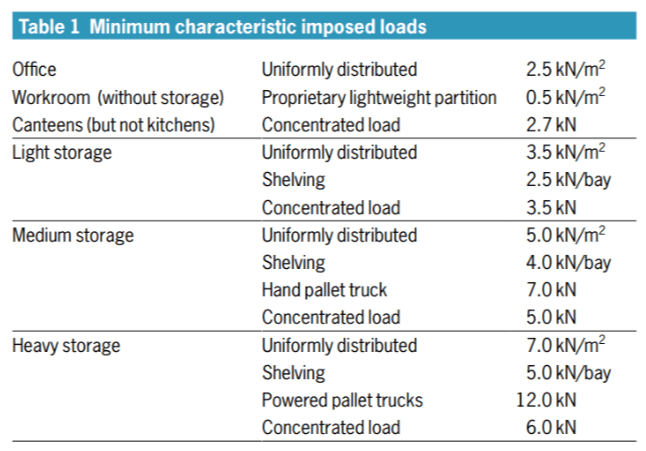
3. Load ratings for different mezzanine uses
Different mezzanine applications require different load ratings.
Typical mezzanine uses include:
- Storage mezzanines
- Office mezzanines
- Manufacturing platforms
- Conveyor support structures
- Retail storage areas
- Pick-and-pack operations
Storage environments usually require higher load capacities because they must support palletised goods and heavy shelving systems.
Office mezzanines generally require lower loads but must account for people, furniture and equipment.
4. The risks of overloading a mezzanine floor
Overloading is one of the most common causes of mezzanine structural problems.
Common causes of mezzanine overloading
Overloading often occurs when businesses modify their operations without reviewing the structural design.
Examples include:
- Increasing storage density
- Adding heavier machinery
- Changing racking layouts
- Installing conveyor systems
- Introducing pallet trucks or robotics
Without proper load reassessment, these changes can place unexpected stress on the mezzanine structure.
If loads exceed the design specification, several issues may occur.
Excessive structural deflection
When loads exceed structural limits, the mezzanine floor may begin to sag or deflect.
This can cause:
- Decking damage
- Structural fatigue
- Reduced stability
Structural fatigue
Repeated overloading can weaken structural components over time, reducing the safety margin of the mezzanine.
Localised structural damage
Point loads from machinery or racking may cause localised structural damage if they exceed the designed capacity.
Operational risk
Overloading can create safety risks for workers and equipment.
This is why mezzanine floors must always be used within their designed load capacity.
5. How Hi-Level’s expertise ensures the right design
Designing mezzanine floors capable of supporting complex loads requires specialist structural expertise.
Hi-Level Mezzanines has been designing bespoke mezzanine floors since 1991, delivering thousands of installations across the UK.
We specialise in large, complex mezzanine structures used in warehousing, logistics and manufacturing environments.
Our team of qualified structural engineers are experts at problem solving.
Bespoke structural design
Every Hi-Level mezzanine floor is designed specifically for the customer’s operational requirements.
Engineers assess:
- Live loads
- Dead loads
- Point loads
- Service loads
- Column loading
- Building slab capacity
This ensures the mezzanine structure is engineered for its intended use.
Advanced structural analysis
Hi-Level’s engineering teams perform detailed structural analysis to ensure every mezzanine meets required safety standards.
This includes:
- Structural load calculations
- Steel design optimisation
- Decking specification
- Column load analysis
This engineering process ensures the finished structure is safe, durable and compliant.
6. Choosing the right mezzanine decking
Decking is the surface layer of the mezzanine floor and plays a key role in distributing loads.
Different decking materials offer different structural performance.
Particle board decking
Particle board decking is used for most purposes. It provides a cost-effective surface for moderate load requirements.
Benefits include:
- Cost efficiency
- Easy installation
- Smooth surface finish
Steel decking
Steel decking is typically used in plant platforms.
It offers capacity for heavier loads and heavy point loads, durability and improved resistance to wear.
Composite decking systems
Composite decking systems combine steel and concrete to create extremely strong floor systems.
These systems offer:
- Extremely high load capacity
- Increased rigidity
- Reduced vibration
These systems are used in heavy industrial environments where very high load capacity is required.
7. The importance of the correct supporting steel
The structural steel framework forms the backbone of the mezzanine floor.
This structure typically includes:
- Primary beams
- Secondary beams
- Steel columns
- Structural bracing
These components transfer loads safely from the mezzanine floor to the building foundations.
Column load considerations
Columns must safely support the combined structural loads.
These include:
- Live loads
- Dead loads
- Point loads
- Factored loads
Engineers must also ensure the building’s existing floor slab can support the column loads.
Beam spacing and design
Beam size and spacing determine how effectively loads are distributed across the mezzanine.
Closer beam spacing reduces deflection but increases material costs.
Structural engineers therefore design beam layouts that balance performance and efficiency.
Why Hi-Level Mezzanines’ professional mezzanine design is essential
Mezzanine floors are powerful tools for increasing warehouse capacity and operational efficiency.
However, successful mezzanine installations depend on accurate load calculations and expert structural design.
Without proper engineering analysis, mezzanines may not safely support their intended use.
By working with experienced mezzanine specialists, businesses can ensure their floors are designed for safety, compliance and long-term performance.

Final thoughts: understanding mezzanine loads
Mezzanine floors are an effective way to maximise vertical space in warehouses, factories and commercial buildings.
However, the success of a mezzanine installation depends on understanding how loads are calculated and managed.
Hi-Level Mezzanines’ structural engineers always consider:
- Live loads
- Dead loads
- Point loads
- Service loads
- Factored loads
Each of these factors influences the structural design, decking specification and supporting steel framework.
By working with experienced mezzanine specialists such as Hi-Level Mezzanines, businesses can ensure their mezzanine floors are engineered to meet operational demands safely and efficiently.
-
Industrial mezzanines are usually constructed from steel frames, decking and ancillary components such staircases and pallet gates.
Typical materials:
- Steel structural framework— beams, columns, joists
- Decking— generally timber however, steel plate and open mesh and concrete are also options including our revolutionary robot-ready Hi-Tile
- Ancillary items such as: Staircases— steel or mixed steel/concrete, edge protection, pallet gates and load plates
- Fire protection materials— fire-rated panels, insulation, protective coatings
- Finishes— paint, lighting, flooring (if offices), partitions.
- Cost and Budgeting
- Structural Design
-
Load capacity varies on design and use. Mezzanines can be engineered for light storage, offices or heavy automation. Hi-Level Mezzanines’ qualified structural engineers calculate loadings precisely to match client needs.
Factors we consider:
- Uniform loads (e.g. storage shelves evenly distributed) versus point or concentrated loads (e.g. heavy machinery, robotics footings)
- Dynamic loads (movement, vibration)
- Floor vibrations, deflection limits.
In robotics and automation projects, the loading per square metre will often be high, and the decking chosen (such as our robot-ready Hi-Tile) must handle heavy, frequent loads without deformation or failure.
- Building Regulations and Compliance
- Planning and Installation
- Sectors and Applications
- Structural Design
-
Yes, when designed properly. Hi-Level Mezzanine’s qualified structural engineers design mezzanine floors to integrate with automation systems such as robotics, conveyors and sortation equipment.
Our revolutionary Hi-Tile flooring is specifically designed for heavy-duty performance, making it ideal for automated operations.
The key is ensuring the mezzanine can support dynamic loads, vibration, frequent movement, load cycles, concentrated loads and integration with conveyors or robotics.
When specifying a mezzanine for automation, Hi-Level Mezzanines will:
- Determine exact load per square metre and concentrated load scenarios
- Use robust flooring such as Hi-Tile that resists wear and deformation
- Provide vibration control if required
- Ensure foundations, bracing and stiffness meet strict engineering tolerances.
- Planning and Installation
- Sectors and Applications