What does a mezzanine floor do?
A mezzanine floor creates one or more intermediate levels inside a building, increasing usable internal floor area without altering the external dimensions.
A single-tier installation effectively doubles the floor area within the footprint. Where height permits, two, three or four tiers can multiply usable area several times over within the same envelope.
The structure consists of steel columns, primary and secondary beams, floor decking and bracing for lateral stability. It transfers loads to the concrete slab through vertical columns and is treated as a permanent structural installation subject to building regulations and fire safety assessment.
Who uses mezzanine floors?
Mezzanine floors are used by organisations that need additional internal floor space without expanding the external footprint.
Primary sectors include:
- Warehousing and logistics
- Manufacturing and production
- Industrial and trade businesses
- Retail and showroom operators
- Facilities and estates managers
The common factor is a building with sufficient internal height and an operational need that justifies a permanent structural installation.
What is a mezzanine floor used for in warehouses and distribution?
What is a mezzanine floor used for in warehouses and distribution?
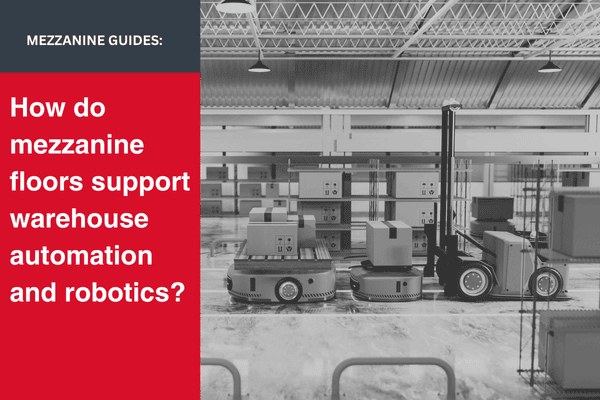
In warehouses and distribution, a mezzanine floor is most commonly used to increase storage capacity — without expanding the building’s footprint.
Rather than taking on a larger unit, a mezzanine creates one or more intermediate levels inside the existing structure. A single tier effectively doubles your usable floor area. Where height allows, multiple tiers can multiply it further — and this is common in high-bay distribution centres and e-commerce fulfilment facilities.
Common configurations include:
- Shelving or racking for smaller items and forward-picked stock
- Bulk pallet storage accessed by a goods lift
- Dedicated pick-and-pack areas separated from bulk storage below
- Returns, sorting and value-added services
- Multi-tier shelving for high-volume e-commerce SKUs
A mezzanine can also be divided to serve more than one function. A common arrangement combines storage on part of the upper level with offices or a supervisor’s area on the remainder — all within the same structure.
It’s worth knowing that the structural specification varies significantly depending on what the mezzanine is carrying. Pallet racking, bulk stock and goods lift reactions impose much higher loads than light shelving — and beam sizing, column spacing and slab assessments are all determined accordingly. Using the wrong load classification creates either unnecessary cost through over-specification, or compliance risk through under-specification.
So if you’re considering a mezzanine for warehouse use, the intended load isn’t just a detail — it’s the starting point for the whole design.
I hope that gives you a clear picture of how a mezzanine floor can work in a warehouse or distribution setting.
In warehouses and distribution, a mezzanine floor is most commonly used to increase storage capacity within an existing building rather than expanding the footprint.
Common configurations include:
- Shelving or racking for smaller items or forward-picked stock
- Bulk pallet storage accessed by goods lift
- Pick-and-pack areas separated from bulk storage below
- Returns, sorting or value-added services
- Multi-tier shelving for high-volume e-commerce SKUs
Pallet racking, bulk stock and goods lift reactions impose significantly higher loads than light storage, and beam sizing, column spacing and slab assessments are determined accordingly.
Can a mezzanine floor be used for offices?
A mezzanine floor is commonly used to provide office accommodation within a warehouse or industrial building, so office and operational functions share the same building.
Office mezzanines are typically constructed with:
- Partitioned or enclosed walls
- Suspended ceilings beneath the floor deck
- Integrated lighting, power, heating and data cabling
- Fire-rated construction to the floor and supporting steelwork
Fire protection is a building regulations requirement, not an option. Office use imposes lower structural loads than storage, but fire safety and compliance requirements are more demanding, affecting programme, specification and cost.
What is a mezzanine floor used for in manufacturing and production?
In manufacturing and production, a mezzanine floor is used to organise production environments, separate operational functions and make efficient use of building height.
Typical applications include:
- Process separation for clean or controlled environments
- Assembly and sub-assembly operations
- Inspection, quality control and testing
- Supervision offices, tool stores and welfare facilities
- Raw material or work-in-progress buffer stock
Machinery that vibrates, rotates or imposes point loads introduces forces that differ from static storage loads, and the structural design must account for these. A mezzanine is not appropriate for heavy manufacturing requiring reinforced foundations or dynamic loads beyond steel deck capacity.
What is a mezzanine floor used for in retail and showroom settings?
In retail and showroom environments, a mezzanine floor is used to extend display or sales area within a building without altering its external footprint.
A second level can accommodate:
- Additional product display and showroom space
- Dedicated brand or category environments
- Customer consultation areas or design studios
- Cafe or hospitality areas
- Staff offices, administration and stock-holding
Public-access mezzanines carry more stringent fire safety and structural requirements than industrial installations. Escape routes, stair geometry, balustrade heights, fire detection and suppression must all meet public-access requirements, which influences cost.
What is a mezzanine floor used for in plant and equipment housing?
A mezzanine floor is used to raise plant, equipment or mechanical and electrical services above ground level, freeing the ground floor for operational use.
Typical applications include:
- HVAC units, electrical switchgear or compressed air systems
- Water tanks, hydraulic equipment or process pipework
- Maintenance access platforms to elevated plant
- Riser systems, cable management or ductwork routing
Equipment mezzanines are typically not continuously occupied. Loads are determined by installed plant rather than occupancy, and design must account for access clearances, ventilation and safety guarding.
Does the intended use affect the structural specification?
The intended use directly determines load capacity, beam sizing, column spacing and fire protection requirements.
Heavier operational loads require heavier structural steel and closer column spacing. Fire protection requirements are governed by occupancy type – office and public-access uses attract more demanding requirements than storage, regardless of structural load.
Using the wrong load classification creates either unnecessary cost through over-specification or compliance risk through under-specification. Intended use must be accurately defined at design stage, including anticipated future change of use.
Can a mezzanine be multi-tier?
A mezzanine installation can incorporate two, three or four tiers where building height permits. Multi-tier installations multiply usable floor area beyond a single intermediate level and are typical in high-bay distribution centres and e-commerce fulfilment facilities.
Each additional tier requires its own structural design, building regulations approval and fire safety assessment. Columns and slab capacity must be sized for the cumulative load of every level above, and internal clear height is the primary limiting factor.
Can a mezzanine floor serve multiple uses at once?
A mezzanine floor can be divided to serve more than one function. A common configuration combines office accommodation on part of the upper level with storage on the remainder, with appropriate fire separation between the zones.
Where different areas carry different load requirements or fire classifications, the structural and compliance design must address each zone independently. The boundary – particularly where fire-rated office space adjoins open storage – is a specific design item rather than an incidental detail.
When is a mezzanine floor not the right solution?
A mezzanine floor is not appropriate in all circumstances. The key constraints are structural, spatial and operational.
Common constraints include:
- Insufficient internal height for the structure and compliant headroom
- Inadequate floor slab capacity, where remedial works are not cost-effective
- Heavy dynamic or vibration loads exceeding steel deck capacity
- Low operational intensity that does not justify the capital cost
- Listed building status, lease restrictions or planning conditions preventing permanent alterations
A mezzanine increases usable floor area within a fixed footprint. It does not resolve fundamental building inadequacies and is not a substitute for a structurally unsuitable building.