The right lighting for your mezzanine is not an afterthought. It is an essential part of creating a safe, efficient and compliant working environment.
Why the right lighting for your mezzanine should be planned from the start
Every mezzanine floor changes the way light moves through a building. Once a new floor structure is installed, the area beneath it will naturally become darker. In many industrial and commercial buildings, particularly large warehouses, there may already be limited natural light. A mezzanine can make that more noticeable unless the lighting is designed properly from the outset.
That is why we consider lighting at the planning stage, alongside the mezzanine structure, fire protection, sprinkler systems, access, ceiling voids and operational layout. The question is not simply “where can lights be fitted?” It is “what work will happen in this space, what level of visibility is needed and how do we make the finished mezzanine ready to use?”
For many clients, the benefit of working with us is that we can design and install lighting as part of the wider mezzanine project. That gives you one coordinated plan, one project team and a finished space that is ready to go live without needing a separate third-party lighting supplier to come in later.
Why lighting matters under a mezzanine floor
A mezzanine floor creates valuable usable space above, but it also creates a new ceiling below. The right lighting will stop the area underneath becoming gloomy, inconsistent or unsuitable for the work being carried out.
This matters because lighting affects far more than how a space looks. It has a direct impact on:
- safety
- productivity
- accuracy
- employee comfort
- compliance
- energy use
- the overall quality of the finished environment
The Workplace (Health, Safety and Welfare) Regulations 1992 require every workplace to have suitable and sufficient lighting, with emergency lighting provided where people may be exposed to danger if artificial lighting fails. For mezzanine projects, that makes lighting a key design consideration, not an optional extra.
Poor lighting can cause practical problems very quickly. If employees are picking stock, reading barcodes, checking product details, operating machinery or moving materials through the space, they need clear and consistent visibility. Dark spots, glare or uneven lighting can slow people down and increase the risk of mistakes.
We have seen this in practice. One client came to us because the space underneath their existing mezzanine was so dark that employees struggled to read detail on products, including barcodes. The warehouse was large, the mezzanine was wide and natural light from either end did not reach far enough under the floor. Reading became a strain and the lighting was no longer suitable for the operation.
That is the kind of problem that can be avoided when lighting is considered at the same time as the mezzanine design.
Different operations need different lighting levels
There is no single lighting specification that suits every mezzanine. The right lighting depends on how the space will be used.
That is one of the first questions we ask: what is the operational use below the mezzanine and what activities will take place on and around it?
A production area, for example, will usually need a higher lux level than an area used for general storage or picking from shelves. A quality control area may need stronger and more accurate lighting than a packing zone. A showroom may need lighting that supports presentation as well as safe movement. A warehouse corridor may need clear, even illumination without unnecessary glare.
Typical operational uses include:
Picking and storage areas
In warehouses and fulfilment centres, lighting needs to help staff identify products quickly and accurately. Shelf labels, barcodes, product codes and picking lists must be easy to read.
If the space under a mezzanine is poorly lit, picking errors can increase and staff may need more time to complete simple tasks. Good lighting helps create a more efficient working environment.
Production and assembly areas
Manufacturing and assembly work often requires brighter task lighting because employees may be handling components, tools, machinery or small elements. Lighting design needs to support accuracy, safety and concentration.
For these areas, we consider not only brightness but also uniformity, glare and the position of fittings in relation to workstations and equipment.
Packing, repairs and sorting rooms
Packing and sorting areas need practical lighting that helps staff check products, read instructions and prepare items for despatch. Repairs areas may need more focused lighting, depending on the type of work being carried out.
For our client Granger Hertzog, the finished build enabled the company to bring more operations in-house, including packing and repairs rooms, a sorting area and a loading bay. These are exactly the kinds of spaces where lighting has to be planned around real daily use.
Loading bays and material handling areas
Loading bays need lighting that supports safe vehicle, pallet and pedestrian movement. Where forklifts, pallet trucks or conveyors are in use, visibility is a core safety requirement.
Lighting also needs to work with the wider layout, including access routes, barriers, pallet gates and fire escape routes.
Offices and staff areas
Many mezzanines include offices, meeting rooms, welfare spaces or staff facilities. These areas may need a different lighting approach from the industrial zones around them.
Cool white lighting may suit operational areas, while warmer lighting may be better for offices, break areas or client-facing spaces. The aim is to create a working environment that feels comfortable and fit for purpose.
Retail, showroom and public-facing spaces
When a mezzanine is used for a showroom, retail area or hospitality environment, lighting becomes part of the customer experience.
The Granger Hertzog project is a good example. We were appointed as main contractor for a larger facility that included a two-tier mezzanine, showroom, offices, staff rooms, toilets, meeting room and kitchen. The finished showroom was designed to be open, practical and full of light and character, helping the firm display its collection across three floor levels.
Lighting in this kind of environment must support safety and compliance, but it also has to help products look their best.
Keith Fyfe, General Manager at Granger Hertzog, said: “We first worked with Hi-Level during the mezzanine installation in our old unit and were very impressed with the quality and delivery of their product. Fast forward a few years, we were pleased to appoint them as our main contractor and had full confidence in their ability to fulfil our requirements.”
That confidence matters. When a mezzanine project includes lighting and wider fit-out works, clients need a team that can coordinate design, build, compliance and delivery.
What types of lighting can be used with mezzanine floors?
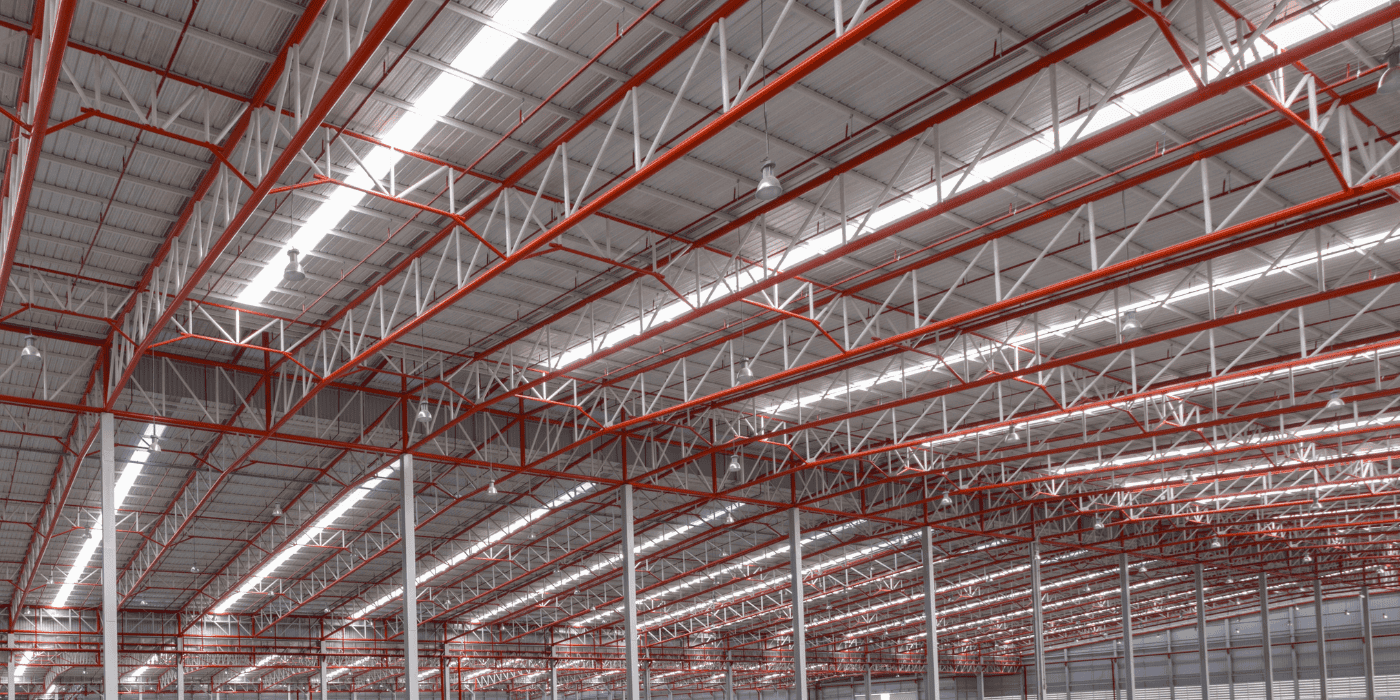
The right lighting specification will depend on the building, the mezzanine design and the operational use of the space. Common options include:
High bay lights
High bay lights are suited to tall spaces, particularly above mezzanine floors or in large industrial buildings where lighting needs to cover a wide area from height.
Linear lighting
Linear lighting is often useful under mezzanines, in corridors and in areas where even illumination is required across a defined space.
Floodlights
Floodlights can support wider coverage where broader illumination is needed, whether indoors or in certain external or loading areas.
Emergency and safety lighting
Emergency lighting is essential for compliance and safe evacuation. It needs to be coordinated with escape routes, staircases, exits and the wider fire safety strategy.
At Hi-Level Mezzanines, we specify lighting with efficiency, safety and compliance in mind. Modern LED lighting can reduce energy use compared with older fluorescent or metal halide systems, while also offering long operating lifespans, low maintenance requirements and instant start-up.
Lighting and compliance
Lighting must be considered in line with relevant regulations and standards. For mezzanine projects, this may include:
- Building Regulations Approved Document B for fire safety
- BS 5266 for emergency lighting
- BS EN 12464-1 for lighting in workplaces
- The Workplace (Health, Safety and Welfare) Regulations 1992
As part of our design approach, we consider the lighting requirements alongside the mezzanine structure and the wider building requirements. This helps support building control approval and gives clients confidence that the finished installation has been planned properly.
Lighting design also needs to take account of practical factors such as lux levels, colour temperature, colour rendering, uniformity, energy use, access for maintenance and the position of other services.
Why mezzanine lighting affects employee wellbeing
In large warehouse buildings, there are often few windows and limited natural light. Once a mezzanine is added, lighting becomes even more important because the area underneath the floor depends heavily on artificial light.
A dark working environment can feel poor quality, even when the structure itself is well designed. Employees may need to strain their eyes, adjust their posture to see clearly or work harder to read labels and product details. Over time, this can affect comfort, focus and morale.
Modern lighting aims to create a better working environment by providing clear, consistent illumination. In some cases, this may mean using lighting that helps emulate daylight and creates a brighter, more pleasant space.
For employers, good lighting is not only about compliance. It is about providing a workplace where people can do their jobs safely and comfortably.
Why lighting should be part of the mezzanine design
Lighting is easier to get right when it is designed at the same time as the mezzanine.
A mezzanine project involves many connected decisions. The structure, ceiling depth, fire protection, sprinklers, access routes, power, data, ventilation, heating, cooling and lighting all need to work together. If these elements are treated separately, the risk of complications and delays increases.
For example, the depth and height of the ceiling may depend on the services required in the void. Lighting is one of those services. The height required below the mezzanine also matters, because it affects how the space can be used and where fittings can be placed.
When we plan everything together, we can coordinate these details more efficiently. That means fewer surprises on site, less disruption for the client and a finished installation that is ready for use sooner.
The value of a single coordinated plan
Clients often come to us because they want a professional partner who can take responsibility for the mezzanine project as a whole.
Lighting is a good example of why this matters. If the mezzanine is installed first and lighting is considered later, there may be delays, extra cost or compromises. Cable routes may not be in the right place. Fittings may clash with other services. The lighting may not suit the final operational layout.
By contrast, when lighting is included from the beginning, it can be coordinated with:
- the mezzanine design
- the steel structure
- fire protection
- suspended ceilings
- sprinklers
- staircases
- escape routes
- pallet gates and edge protection
- power and data
- operational zones
- future expansion plans
This gives the client one view of the project and one team managing the detail. It is simpler, more efficient and more accountable.
Why Hi-Level Mezzanines is well placed to handle lighting
We are not just mezzanine floor installers. We design, manufacture and install bespoke mezzanine floors for commercial and industrial environments, with project management from concept to completion.
That means we understand how lighting fits into the wider structure and how it affects the finished workspace.
Our role is to help clients make good decisions early. We ask how the space will be used now, how it may need to change in the future and what services need to be included from day one. That enables us to create a mezzanine design that supports the client’s operational goals rather than simply adding floor space.
Our value-engineered approach also applies to lighting. We plan the correct number and position of lights without over-specifying fittings or creating unnecessary cost. The aim is a practical, safe and efficient system that works for the space.
For larger commercial and industrial projects, this integrated approach can make a major difference. Clients want a good return on investment, minimal disruption, clear accountability and confidence that the finished project will be delivered professionally. Lighting is part of that.
Common lighting mistakes to avoid
Lighting problems often arise because the design is not linked closely enough to the mezzanine and the operation.
Common mistakes include:
- leaving lighting until after the mezzanine has been installed
- using a general warehouse lighting layout that does not account for the new floor
- failing to consider different tasks in different zones
- creating dark spots under large mezzanine areas
- installing fittings that cause glare
- overlooking emergency lighting requirements
- failing to coordinate lighting with sprinklers, ceilings and fire protection
- underestimating the importance of employee comfort.
These issues can usually be avoided with early planning.
Questions to ask before specifying mezzanine lighting
Before lighting is specified, it is useful to ask:
- What will happen beneath the mezzanine?
- What will happen on the mezzanine?
- Will the space be used for storage, picking, production, packing, offices or showroom use?
- Are there areas that need higher lux levels?
- Will employees need to read labels, barcodes or detailed product information?
- Are there machinery, conveyors, robotics or material-handling systems to consider?
- Where are the escape routes, staircases and emergency exits?
- What other services need to sit in the same ceiling void?
- How can the lighting be installed with minimal disruption?
- How might the operation change in the future?
These questions help us design lighting that reflects the real use of the space, not just the shape of the building. They also mean we can future-proof your project so your mezzanine helps your business expand.
Make your mezzanine ready to work from day one
A mezzanine floor is a major investment. It will allow you to maximise vertical space, improve efficiency and support the way your business operates. Lighting plays a vital role in achieving that.
When lighting is designed as part of the mezzanine project, the result is safer, clearer and more efficient. Staff can work comfortably. Operations can start sooner. The finished space feels properly considered. Compliance requirements are easier to manage. And the client has one expert team responsible for pulling the project together.
At Hi-Level Mezzanines, we design and install mezzanine floors with the whole working environment in mind. From the steel structure to lighting, fire protection, access and fit-out, we help create spaces that are practical, compliant and ready for the future.
If you are planning a mezzanine project and want lighting that works from the outset, contact our team. We will help you design a mezzanine that gives your business the space, safety and efficiency it needs. Contact us to find out more.